
Table of Contents
Election night at a lot of camera clubs goes something like this. The nominating chair reads the slate, and it’s the same four names as last year, or there’s a blank where the vice president should be. Somebody cracks a joke about term limits, everyone laughs a little too hard, and the current president agrees to do “one more year.” Gosh, that sounds familiar.
I’ve spoken at more than a few clubs where the president was also running the website, the competitions, the speaker calendar, and the coffee pot. People like that are the reason many clubs still exist. They’re also exhausted, and when they hit the wall, the club discovers it never had a plan B.
Want the printable version? Jump to the free Club Crew Planner.
People Still Want to Help
It’s easy to assume people just don’t volunteer anymore. The data says otherwise. According to AmeriCorps and the Census Bureau, about 28 percent of Americans volunteered through an organization in 2023, climbing back from a low of 23 percent in 2021. Meanwhile, 54 percent helped neighbors and friends informally, up from 51 percent.
People are still willing to help. What they avoid is the formal commitment that never seems to end, and from the outside, “club president” looks exactly like that.
Why Nobody Raises Their Hand
Think about how the president’s job looks to someone who joined two years ago. No written description, no end date, and a current president who seems to do practically everything. Who in their right mind volunteers for that?
Younger members feel this even more. In Deloitte’s 2025 survey of more than 23,000 Gen Z and millennial workers, only 6 percent of Gen Z said reaching senior leadership is their main career goal. A Robert Walters survey of 3,600 Gen Z workers found that 72 percent would rather advance without managing anyone, and nearly 70 percent called management “too high stress, low reward.”
This next part is my opinion, based on what I’ve seen rather than a study. A lot of the younger members I meet at clubs are happy to do real work. What they don’t want is to stand at the front of the room every month or be the one who tells a longtime member that his competition entry was disqualified. Our traditional titles bundle the spotlight and the conflict together with the work. Untangle them, and you’ll be surprised who raises a hand.
Retirees are in the same boat. The member who winters in Arizona isn’t signing up for a two-year presidency either.
Other Organizations Already Figured This Out
The League of Women Voters offers its chapters shared presidencies and management teams because it was “increasingly difficult to find a candidate willing or able to devote so much time to a volunteer position.” The Road Runners Club of America tells its clubs flatly that “the president should not be tasked with nor take on all of the duties” of the board. Camera clubs can do the same.
Break the Big Jobs Into Small Ones
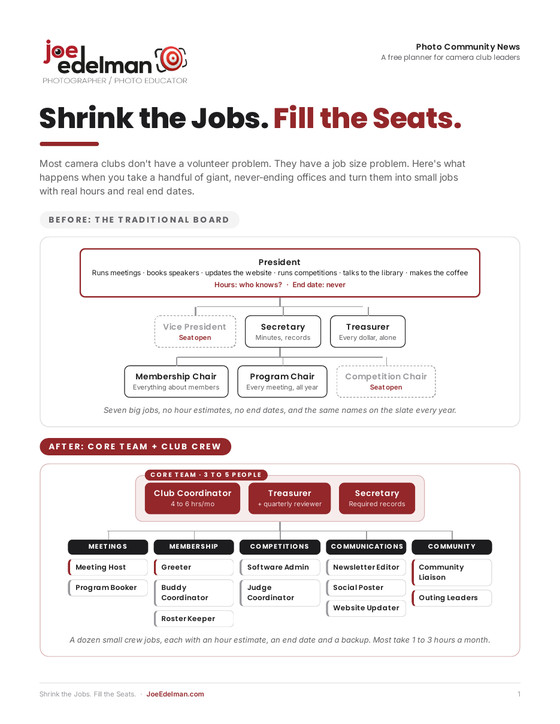
Here’s what I’d suggest. Keep a small core team of three to five people who make decisions and cover any offices your bylaws or state law require. Everyone else joins the club crew, and each crew member takes one small job with a short written description, a realistic hours-per-month estimate, and an end date six to twelve months out.
Here’s a sample. The hours are my rough estimates, so adjust them for your club.
- President becomes a Meeting Host who runs the meeting and introduces speakers (about 3 hours a month), a Club Coordinator on the core team who keeps the calendar and checks in with the crew (4 to 6 hours), and a Community Liaison for the library, camera store, and local paper (about 2 hours).
- Vice President, often the vaguest job in the club, becomes a Program Booker who lines up speakers and workshops (about 3 hours).
- Membership Chair becomes a Greeter for meeting nights only (1 hour), a New Member Buddy Coordinator (2 hours), and a Roster and Renewals Keeper (1 to 2 hours, mostly in your membership software).
- Competition Chair becomes a Competition Software Admin (about 3 hours per month during the season) and a Judge Coordinator (about 2 hours).
- Communications becomes a Newsletter Editor, a Social Media Poster, and a Website Updater (1 to 3 hours each).
- Outings become Outing Leaders, one walk at a time. Half a day, once, done.
- Treasurer stays one person, plus a second reviewer who looks over the books every quarter.
Half of those jobs never require standing in front of anyone, which makes them perfect for your quietest members.
Four Things That Keep This From Falling Apart
1. Cut before you split. Divide a bloated job into five pieces, and you get five bloated jobs. Drop the tasks nobody would miss, and let software handle renewals and payments.
2. Somebody still has to coordinate. Small jobs drift without someone connecting them. That’s the Club Coordinator’s real job, backed by a shared task list.
3. Respect the money and the law. Keep the treasurer as one accountable person with a second set of eyes. If your club is incorporated, most states require a president, secretary, and treasurer, so check your state’s rules and your bylaws before renaming anything official. The crew roles can live right alongside those titles.
4. Ask people, one at a time. In an AARP survey, the most common reason people gave for not volunteering was that nobody asked them (41 percent). A plea for “volunteers” from the podium gets crickets. “Would you be our Greeter for six months? It’s about an hour on meeting nights” gets a yes far more often than you’d expect.
Give Every Job an End Date
An end date makes a small job feel safe to accept. Pair every crew role with a backup who learns it along the way, and when the term ends, someone is ready to step in. That’s the start of a real succession plan, which I’ll dig into in December.
Start Here
At your next board meeting, list every task your officers actually did last year and roughly how long each took. Cross out anything nobody would miss, group the rest into small jobs with hours and end dates, and then go ask people face-to-face.
Your club probably has plenty of people willing to help. The jobs are just too big for anyone sane to accept. Make them smaller and watch what happens.
Now go pick up that camera and shoot something! Because – “Your BEST shot is your NEXT shot!” — Joe Edelman
The Club Crew Planner
Everything in this article, ready to print and bring to your next board meeting.
- Before-and-after org chart: traditional board vs. core team and crew
- 16 role cards with hours and terms already filled in
- Word-for-word scripts for asking members to say yes
- A fill-in worksheet to put a name next to every job
Free. No sign-up required. Print it, copy it, share it with your board.