Table of Contents
A Confession From the Front Seat
A while back, I was driving home with my camera sitting on the front seat beside me, which is where it more or less lives.
I spotted something alongside the road that gave me that feeling every photographer knows. Your brain sends a very clear message: I like to call it the “ooh” moment.
But then the other voice showed up – the one that makes excuses. The light is not good. You do not have the right lens for this. By the time you pull over and get the camera out, whatever you are seeing will be gone. Is it even worth pulling over for?
I kept driving.
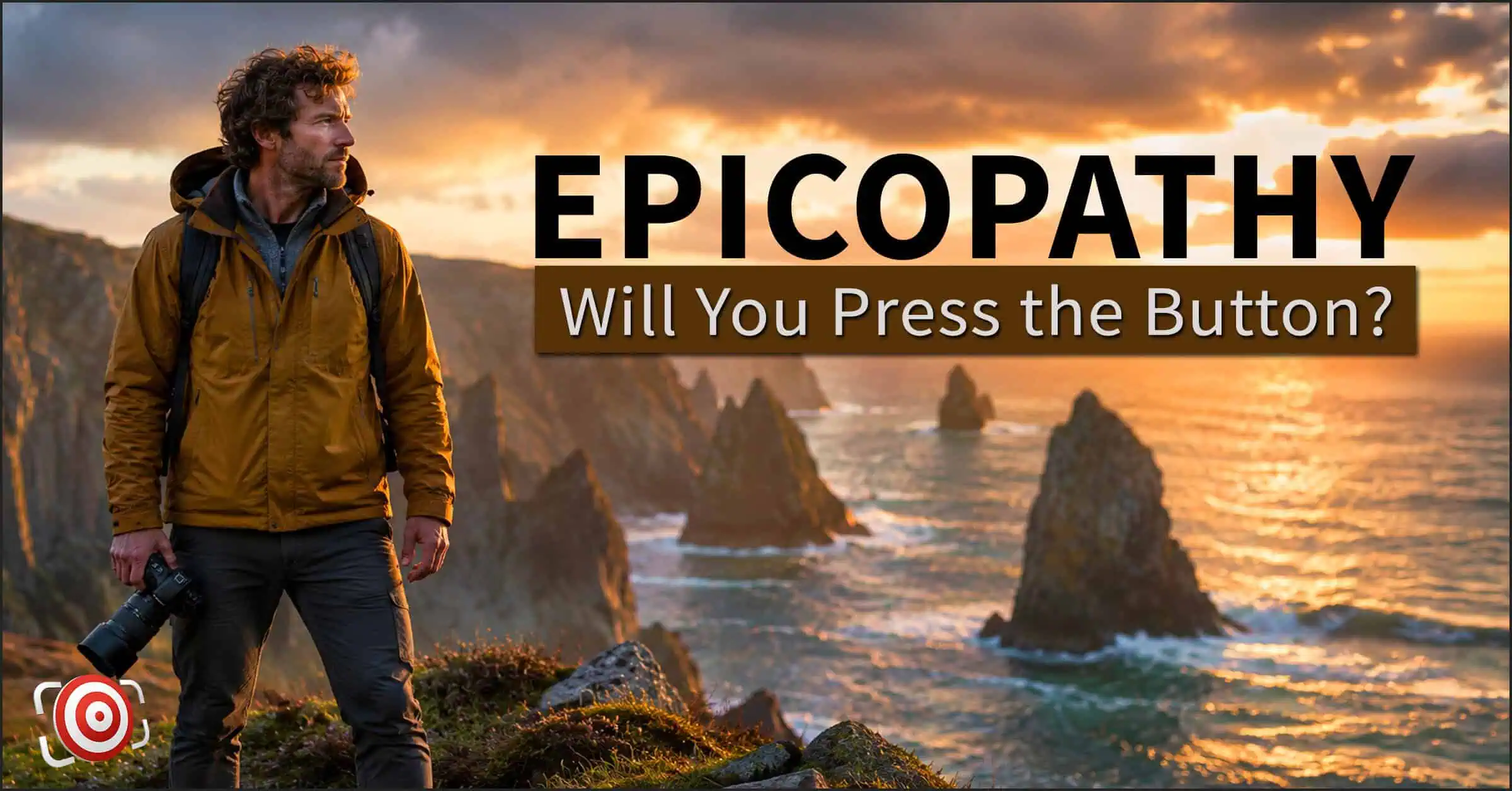
Before you feel too much sympathy, I want to be clear: that was not a proud moment. It was a textbook case of a condition I have become all too familiar with over 55 years of shooting, one that a friend of mine put the perfect name to. He called it epicopathy. I adopted it on the spot. Simply put, epicopathy is the condition where a photographer will not press the button unless the picture is going to be epic.
If you have never done this, feel free to move on to another article. For everyone else, read on, because this habit is costing you more than you probably realize.
Every Photographer Has This Problem
I want to be upfront about something: I am not writing this from the comfortable position of someone who figured this out decades ago and has been immune ever since. I regularly deal with epicopathy. And with 55 years of experience behind me, I arguably deal with it in a more sophisticated and convincing way than a photographer just starting out.
For a beginner, epicopathy usually comes from fear. You are still learning, still uncertain, still comparing your unfinished work to the polished images flooding your social media feeds, and the gap between what you see in the viewfinder and what you see online feels embarrassing before you have even pressed the button. The internal voice shuts the whole thing down.
For a more experienced photographer, the flavor is different, but the result is the same. In my case, it is the “been there, done that” voice. With decades of reference points in my head, I can size up a scene in seconds and start cataloging all the reasons it is not interesting enough: the light is flat, I have shot something like this before, I do not have exactly the right glass with me. I have to actively remind myself that the only way to find out what is actually there is to pick up the camera and start working.
Same disease. Different symptoms.
The Two Villains
If I had to point to two things equally responsible for epicopathy, it would be perfectionism and social media, and the reason they are both guilty is that they feed each other in a particularly nasty way.
Anyone who really cares about their work is likely somewhat of a perfectionist. If the work matters to you, the idea of producing something mediocre feels like failure before the shutter fires. That is not a character flaw. That is the natural byproduct of having standards. The problem is when those standards become a barrier to creating anything at all.
Then you add social media, and the situation gets considerably worse. Instagram, YouTube, and every online photography community present you with a relentless stream of best-in-class images from photographers who shot hundreds of frames to get one keeper, processed the result for hours, and built entire careers around making that work look effortless. You scroll through that on a Tuesday evening, pick up your camera on Wednesday morning, and the gap between what you see in front of you and what you were looking at the night before feels like a canyon. The internal voice that was already suspicious of your work now has plenty of evidence.
This is not a beginner problem. This is not an experience problem. Social media has infected photographers at every level, including those good enough to know better.
What Epicopathy Actually Costs You
The most obvious cost is the shot itself. The moment that caught your eye. The thing that would have made a photograph, or maybe a great photograph, or maybe just an interesting snapshot worth keeping. That is gone, and you cannot retrieve it.
But that is actually the smaller cost.
The higher cost is to your visual database. Photography is an experiential skill. Every image you take, including the imperfect ones, including the ones you would never show anyone, adds to a bank of visual experiences that your eye and your brain draw from every time you pick up a camera. The quick grab in bad light teaches you exactly what bad light looks like so you can recognize and solve it next time. The uncomfortable situation forces you to make decisions under pressure, which is the only way to develop real instincts. Every time epicopathy wins and you put the camera down, you also skip the lesson that shot was going to deliver.
There is a double tax on every shot you talk yourself out of. Not only do you lose the photo, but you also lose the growth opportunity. Also, over time, that adds up in ways that are hard to measure but very easy to see in someone’s work.
The Day I Almost Drove Past a National Enquirer Photo
Early in my career, at my first newspaper job right out of high school, I got a call to go to a traffic accident where a tractor-trailer had lost its rear set of wheels. I was about five minutes away and got there quickly, actually before the police arrived. What I found was a set of twin rear wheels lying upside down in the intersection, the trailer bottomed out, and the driver standing nearby looking at the damage. Nobody was hurt. There was not much to see.
I was genuinely disappointed. This did not look like a story. I almost got back in my car and left without taking a single frame, but I stopped myself with one thought: going back to the paper with nothing is not professional. The least I could do was document what was there.
I decided to walk down the roadway a bit with a telephoto lens so I could frame a shot that included the traffic lights, the intersection, the truck, and the flipped wheels all in the same frame. As I was settling into my position, the driver walked back past the trailer carrying a couple of road flares. He set them on the metal section of the wheels, and one of them slid down between the tire rims. He leaned over to look for it, and in that moment I realized: shoot now, and shoot fast. I got off two frames before he stood back up.
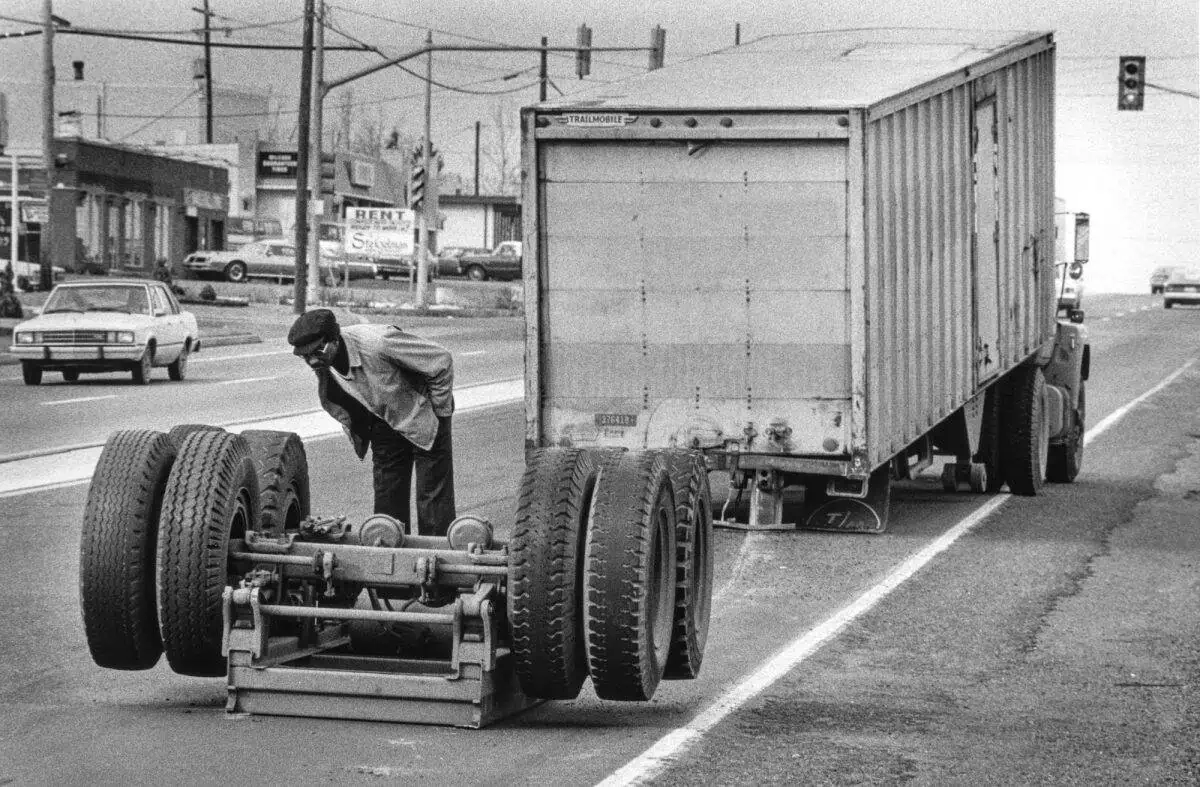
What I wound up with was a photograph that told the complete story of the accident, with the driver bent over the wheels in what looked like genuine disbelief. That picture ran was transmitted nationally by the Associated Press and it ran as a funny photo in the National Enquirer. It appeared in several books. I licensed it to multiple attorneys involved in lawsuits against the trailer manufacturer for years.
I nearly drove past all of that because nothing looked epic enough. You see, epicopathy has been around for years – long before social media!
The Cure Starts With Pressing the Button
Here is where some discipline comes in, especially if your instincts have been running in the opposite direction for a while.
Press the button first. The feeling that catches your eye (That “ooh” moment”) is your signal, not a guarantee of anything. When something registers as a potential photograph, your first job is not to evaluate it. Your first job is to capture it before it is gone, because analysis can wait about 15 seconds and the moment often cannot.
After that first frame, apply what I think of as the why test. Why did this catch your eye? What were you actually responding to? Was it the light, the subject, a moment of action, a composition possibility? Knowing your why does not just improve the next frame. It changes the entire direction of the session, because now you know what you are actually trying to communicate.
Here is something I believe strongly enough to say bluntly: if you pick up a camera, take one or two frames, and put it back down, you have mostly wasted your time. I do not say that to be harsh. I say it because I mean it, and I would say the same thing about my own shooting. Nobody, regardless of experience level, is so good that the first frame is the finished image.
Work the Shot
For me, the first frame is opening the door. It is the entry point that says: there is something here, now let’s find out what it actually is.
This idea of working the shot is something I talk about a lot, because I think it is genuinely one of the most underused habits in photography. Once you have pressed the button and you know your why, stay. Explore. Try different angles. Try different framing. Push past your first instinct and see where the scene can take you, because that is where the interesting things start happening. With my experience, I can make better decisions earlier in that process than a newer photographer would, but the process itself never goes away, and I would be foolish to think otherwise.
Working the shot also builds the visual database that epicopathy starves. Every time you stay and explore, you create experiences that get carried into the next session. Every session where you talk yourself out of shooting produces nothing.
What Untreated Epicopathy Looks Like
A few years back at a trade show, a photographer came up to me very excited and told me my YouTube channel was his favorite weekly television show. He was genuinely enthusiastic, and I appreciated it. But I have a habit of asking the same follow-up questions with everyone who tells me they enjoy the work, because there is no better way to understand how your material is actually landing.
As we talked, it became clear that this man owned a lot of gear, bought most of the new equipment that came out, and rarely took pictures. By his own admission, he was not improving his work in any meaningful way. My channel was entertainment he genuinely enjoyed, the same way you enjoy a good show on a Sunday afternoon.
That is the end stage of untreated epicopathy. You stop being a photographer who occasionally talks yourself out of shots. You become a spectator of photography, consuming other people’s images, watching other people’s tutorials, and buying better gear as a substitute for actually shooting. All of the interest, none of the practice.
I am not suggesting that is where you are headed. But I do think it is worth knowing where the road eventually goes if you stay on it long enough.
Press the Button
You do not have to resolve whether a shot is going to be great before you take it. That question answers itself after you press the button, not before. The feeling in your gut exists for a reason. Trust it enough to find out what it is pointing at.
Now go pick up that camera and shoot something! Because – “Your BEST shot is your NEXT shot!” – Joe Edelman