Table of Contents
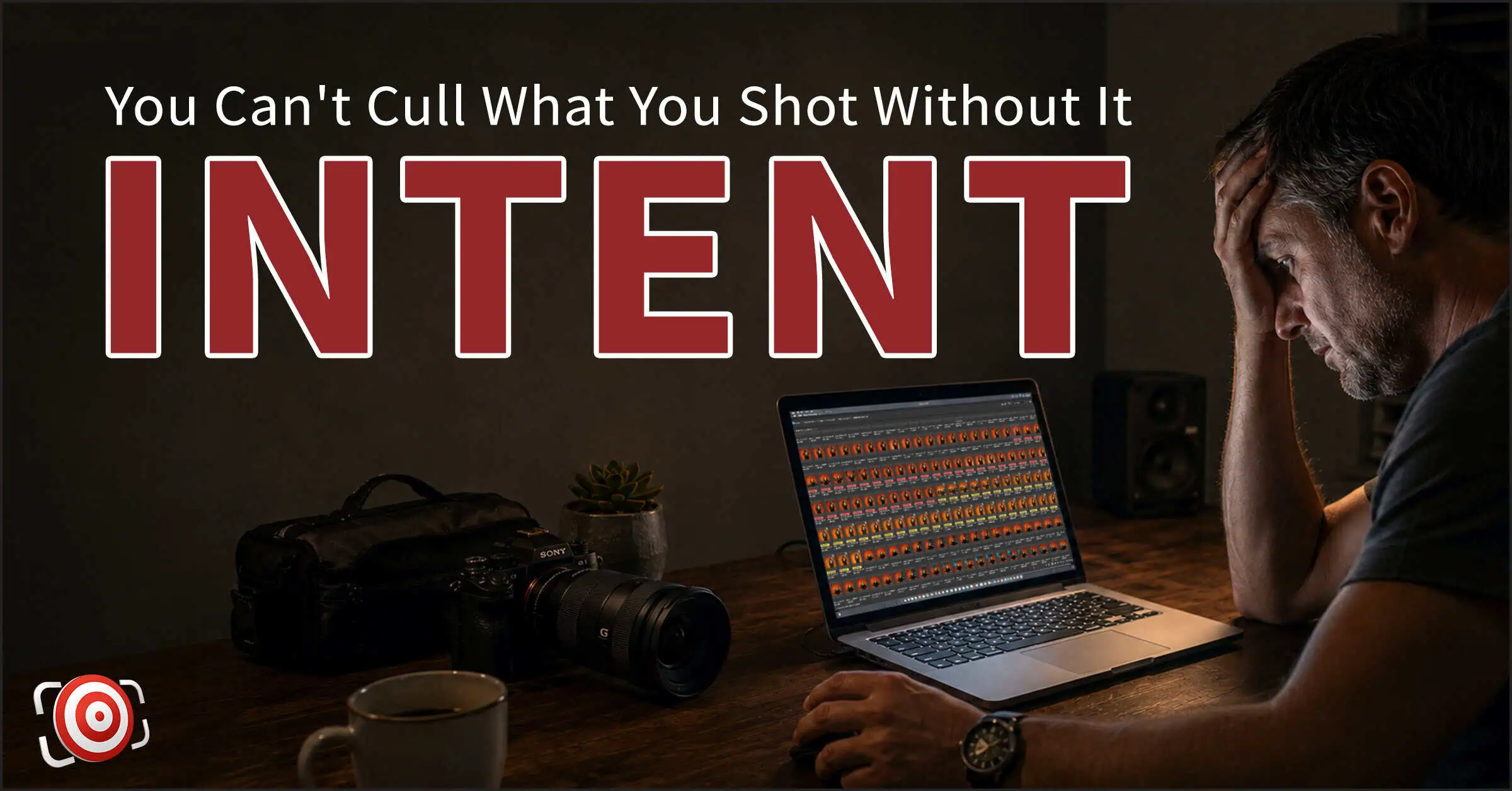
Culling feels impossible because of a decision you skipped when you were shooting.
I am going to start with the tough love. If you cannot pick your best shot, the problem didn’t happen at your computer. It happened the second you raised the camera because you didn’t decide what you were after in the first place.
I hear this from beginners to working pros who have been at this for years. “I have a really hard time picking my best shots.” Almost every photographer alive has said it or thought it, so if that is you, you are in good company.
But I need to be blunt with you because being nice about this would do you a disservice. If you find yourself having a hard time picking the best frames, it confirms that you walked into the shoot without a clear idea of what you wanted, you fired away, hoping something good would happen, and now you are staring at 300 frames, asking the pictures to tell you which one matters. They cannot. That was your job, and you skipped it.
Here is the part nobody wants to hear. The photographers who struggle to cull are almost never the ones who shot too little. They are the ones who shot without intent. Fix the intent, and the culling fixes itself. The fix costs you nothing but the willingness to think before you press the button.
Culling: The process of selecting your best images and discarding the rest. Learn more
Culling Doesn’t Make the Decision. It Reveals One You Already Made.
Here is the myth I want to take apart: people treat culling as a separate skill you perform at the computer after the shoot, and they assume some folks are just born better at it. “I’m a good shooter; I’m just bad at picking the best ones.” That is backward.
Culling is not about deciding on the best shot. It is where the decision gets revealed. The real work should have happened when you were shooting. If you can’t pick your best frame while sitting at your computer, it is almost always because you never decided what your best frame was supposed to be before you shot it. The agony you feel scrolling through that folder is not an editing problem. It is the bill coming due for a decision you never made.
The Mentee Who Couldn’t Choose
I mentor a number of photographers, and recently I was working with a guy who had just finished a branding shoot. His client was a young woman who needed images for her social media and for the marketing around a book she is writing. Real work, with real money on the line. And he came to me, stuck. He said, and I am quoting him, “I’m just not sure which ones are the best ones.”
Now, I think a lot of this guy, and I said to him exactly what I am about to say to you. That is a lazy answer. Not because he didn’t work hard, it is lazy because “I’m not sure which ones are best” is where you stop thinking, when it should be where you start. You should be sure. Within reason, you should be able to look at your take and know. The fact that he couldn’t tell me everything I needed to know about how the shoot actually went.
I asked him about it, and here is what came out. This young woman walked into his studio, full of energy, animated, and ready to move and strike a pose. In some frames, she is looking directly into the camera for a clean, clear portrait. In others, she is mid-gesture. His approach, by his own description, was to capture all of it. He was like a guy hanging onto a roller coaster for dear life, gripping the camera and firing, trying not to miss anything she did.
That, right there, is why he struggled to cull. He didn’t shoot with intent. He shot to capture everything, which is another way of saying he made no decisions at all. He let his subject drive, and he handed off every real decision to later. To the edit. And later showed up with the decisions harder than ever, because now he had hundreds of frames and no standard to judge them against.
Here is what should have happened. Before he picked up the camera, or at the very least before each section of the shoot, he should have had a real conversation with her and with himself. What are we trying to accomplish here? What does she actually need? Is it the clean headshot for the book jacket, the loose, energetic stuff for Instagram, or the confident hero shot for the top of her website? Since it was a branding shoot, he probably needed it all.
But each one has a different intent. And the moment you have that intent, culling stops being a guessing game, because now every frame gets measured against a target. Did this frame deliver the confident hero shot? Yes or no. The keepers are the ones that hit the target. The rest fall away, and they fall away without the agony, because you are not asking “is this a good picture?” you are asking “did this do the job I set out to do?” That is a question you can actually answer.
Why This Is So Hard, Backed by More Than My Opinion
I am not just calling everybody lazy. There are real reasons culling wrecks people, and you need to see them clearly.
The first is anxiety. A lot of photographers are flat-out afraid to cull. They are terrified that somewhere in that folder is their best shot, and that if they delete the wrong file, it is gone forever. They keep everything, and the fear of losing “the one” keeps them drowning in the hundred.
I understand it, but you have to see what that fear really is. It is the fear of making a decision and being wrong. The cure is not keeping everything.
The cure is having standards and shooting with intent, so that “right” and “wrong” actually mean something when you sit down to cull your work. Hoarding has a cost beyond the paralysis, too. Those frames eat storage and backup space, and you will never look at most of them again as long as you live.
The second reason is emotion, and this one runs especially deep for hobbyists. You were there. You remember making the picture, the light, the way it felt. Every frame carries meaning for you, so deleting one feels like throwing away a memory. That special meaning is yours and yours alone. It lives in your head and your heart, not in the frame. The viewer was not there. All the viewer gets is what is inside that rectangle. When you keep a weak image because of what it means to you, you are not serving the picture or the viewer.
Now, you may have read that the real culprit is “decision fatigue” and that your judgment falls apart around frame five hundred because your brain is literally running out of glucose. The culling blogs love that line, and the AI software companies love it even more, because it sets up their product as the cure. I want to be straight with you. That brain-fuel story does not hold up. It comes from a theory psychologists call ego depletion, and when 23 separate laboratories and more than 2,000 participants tried to reproduce the effect, they couldn’t. After correcting for the way these results get published, the effect was basically zero.
You can read about the collapse of that theory here. Your brain is not running out of sugar. The honest version is simpler, and you already know it from experience. Making hundreds of fine decisions in one sitting with no standard to anchor them is miserable, and it dulls your judgment. The problem is not your blood sugar. The problem is that you went in without a target. That is exactly why the multi-pass method I am about to give you works, and it has nothing to do with eating a candy bar.
The Client Problem: Why Over-Delivering Costs You Money
I am giving this one its own section because so many of you do client work, even if it is just for friends and family.
When you cannot cull, you over-deliver. You hand the client everything because you couldn’t decide, and then you dress it up as generosity. “Look how many options I gave you.” Here is what actually happens. You overwhelm them. You hand a person who is not a photographer 150 proofs, and you have just given them the same paralysis you were trying to escape, except it is worse for them, because it is not even their craft.
Here is the part that should land, and it is not just my opinion. Over-delivering does not lead to more sales. It does not lead to more prints on the wall or more downloads. Experience says the opposite, and so does the most famous study in the entire field of choice. In 2000, researchers Sheena Iyengar and Mark Lepper set up a tasting table at a gourmet grocery store. Some hours they displayed six jams, other hours twenty-four. The big display pulled more lookers, no surprise there. But when it came to buying, the table of six jams converted about 30 percent of tasters, while the table of twenty-four converted about 3 percent. That is a ten-to-one difference, and it points in the same direction my client’s work has pointed for decades. You can read the original paper, When Choice is Demotivating, here.
In fairness, researchers have argued ever since about how far that jam result stretches, and some have had trouble reproducing it under different conditions. I am not going to pretend that one grocery store will settle the photography issue forever. But when a landmark experiment and 50 years of watching real clients tell me the same thing, I pay attention. Show people everything, and they buy less, because they shut down.
Clients will always tell you they want lots of options. Always. But what they really want is for you to be the expert they hired and to steer them. When you deliver a tight, curated set of your best work, you are not giving them less. You are giving them your expertise, which is what they actually paid for. Anybody can hand over a memory card. They hired you to know which frames are the keepers.
A Word on the AI Culling Software
You knew this was coming. There is now a whole category of software that promises to cull your photos for you, sorting your take and ranking your keepers. I am not a fan and strongly discourage them if you are trying to improve your photography.
Yes, these tools can sort fast, and several even have rapid AI processing capabilities. What they cannot do is supply the standard you skipped. An AI can tell you which frames are sharp and which eyes are open. It cannot tell you which frame delivered the confident hero shot for the top of that woman’s website, because it has no idea that was the goal. You never told it. You didn’t know yourself.
AI software can’t understand your intent.
Intent is the main ingredient that the software lacks. What these programs really do is help you machine-sort the consequences of a shoot you took with no plan, only faster. You end up with a tidier pile of frames you still cannot truly judge, and you have handed off the most important act of your craft, deciding what matters, to a program that was not in the room. The fix for bad culling was never a faster sorter. It was a clearer head before you pressed the button.
Is there a business model where AI culling makes sense? Sure, for event photographers who are focused on quantity, automated software is a wise financial decision. For the rest of us, AI culling is a lazy approach that yields average results because AI is built on averages.
I’ll spare you my thoughts on companies that create AI culling software and also create software marketed as a way for people to get great headshots without paying photographers. Let’s just say that those companies should fail on principle or stupidity – you can decide.
The Method: How to Actually Do This
Here is the process /method, in the order it actually happens.
- Decide your intent before you raise the camera. Before each setup, answer one question, out loud if you have to. What am I after here? That sentence becomes the standard you hold every frame accountable to later.
- Cull cold, not hot. Don’t edit your shoot the second you get home, still full of adrenaline from a great shoot. The emotion I talked about is strongest right after you press the shutter. Give it a day if you can, then come back with fresh eyes and judge the pictures, not the memory.
- Do multiple passes. Don’t try to find your single best frame in one pass. Move quickly through the first pass, and kill the obvious rejects. Don’t stress over it; just clear out the junk. Second pass, narrow what is left to the real contenders. Final pass: pick the ones that meet your intent. Multiple passes, each one thinning the flock, are much easier and faster than doing the whole job at once, not because of brain chemistry, but because you shrink the problem before the hard calls.
- Deliver tight. Whether it is a paying client or you are just posting to Instagram, show your best work, not all your work. Every weak image drags down the strong ones around it. Your gallery is judged by its weakest picture, not its best. Be ruthless. The cut is the craft.
Pro Tip: The Intent Sentence
Before you compose a shot, finish this sentence out loud: “In this frame, I am trying to ___.”
If you can’t complete that thought, don’t press the button yet.
Here is what it sounds like in practice. At a portrait session: “In this frame, I am getting the confident hero shot for the top of her website.” At a ballgame: “In this frame, I am anticipating the play at second base,” and on the next one, “I am grabbing a clean shot of the batter in the on-deck circle.”
By comparison, “I am shooting a portrait” is not the intent. That is a category. Intent is the reason behind this specific frame, every time the camera comes up. Shoot that way and every frame practically culls itself afterward, because each one was made to do a specific thing.
“But You Told Me to Work the Shot and Fire Away”
If you have read my article on how to work the shot, you might think I am contradicting myself. There, I tell you to stay on a subject and shoot forty-five frames. Here I am warning you against firing away. Let me clear that up, because the two are not in conflict.
Spray-and-pray is shooting with no real target. Working the shot is shooting toward a target and then refusing to assume your first idea was the best one. You still start with intent. You walk up with an idea. But once that idea is in the viewfinder, especially when you are collaborating with a model or a makeup artist, you stay open to the better, more creative version sitting one angle or one crop away. One approach makes culling easy because every frame was an experiment with a purpose. The other makes culling a nightmare because no frame had one.
The Honest Exception
I want to be fair because I am not interested in calling careful photographers lazy. There is a real difference between the two situations that look the same from the outside.
If you cannot get from 300 frames down to 20, that is the intent problem I have been describing, and it is fixable upstream. But if you have already done the work, you are down to your three or four genuinely strong frames, and now you are agonizing over which nearly identical expression is the keeper, that is not laziness, and it is not a failure. That is taste, and the final fine cut is hard for everyone, including me. The difference is the scale of the problem. Good intent should get you from the hundreds to the few almost automatically. Picking the single best of the handful is the part where you are allowed to sit with it or even keep two. Just do not confuse the easy decision you skipped with the hard one that comes at the very end.
Intent First, and the Rest Takes Care of Itself
Remember that culling is not a separate skill that you apply after the shoot. It is the back half of shooting with intent. When you decide on the goal before you press the button, you are not just making better images in the moment; you are making the edit easier and more effective.
The photographer who shoots with intent sits down at the computer already knowing what the outcome should be. The photographer who sprayed and prayed sits there, asking the pictures to make a decision they cannot make. Do not be that second photographer.
If you are afraid of deleting the best shot, understand that every frame you take is teaching you something, even the rejects. The blinks and the variations that did not work help you build the visual database your eye draws from next time you go out to shoot.
You get good at choosing by choosing. You don’t learn anything by hoarding.
The real lesson here is the same one I keep coming back to. Before any of it, you have to ask yourself the most important question in photography, which is simply why. Why am I raising the camera right now? Answer that, and the keeper is chosen before you ever sit down to look.
Here is the only homework I will give you. Before your next shoot and before every setup, write down one sentence. What am I after here? Then cull only against that. If you cannot pick your best shot, the fix is not a better editing app, and it is definitely not an AI. The fix is intent.
Now go pick up that camera and shoot something! Because – “Your BEST shot is your NEXT shot!” — Joe Edelman