Table of Contents
This article was originally published in the Photo Community News email newsletter.
“Photography may start as a solo pursuit, but no photographer grows alone.”
Sounds like a contradiction. It kind of is. Most of photography happens with nobody else around. You’re out chasing light alone before sunrise, and you’re alone again at the computer for hours afterward, culling files nobody else will ever look at as closely as you do. Fifty-five years in, I still love that part of it.
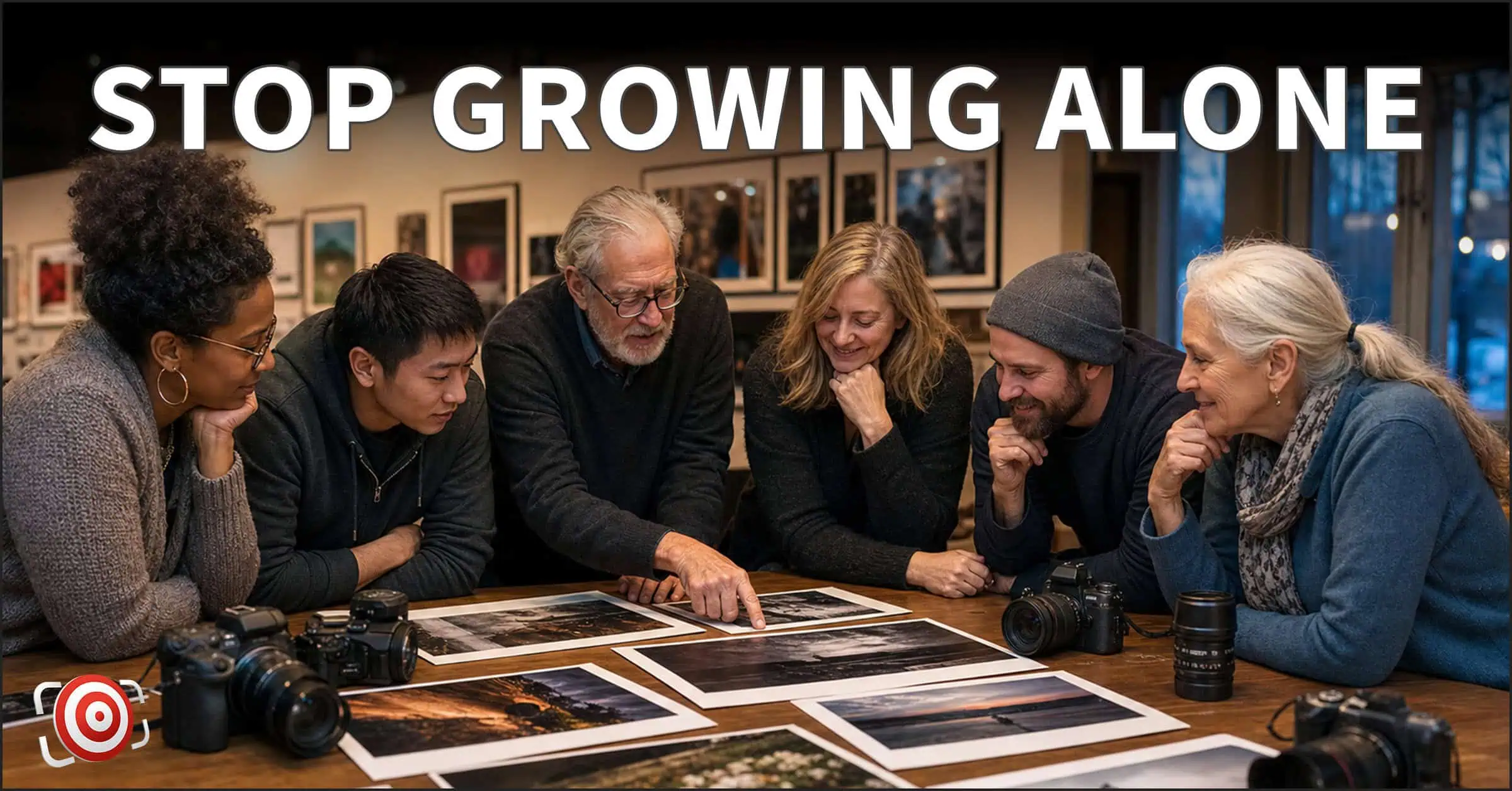
Here’s the thing, though. Nearly every photographer I know who kept getting better, decade after decade, found people to do this with, whether that was a formal camera club, a critique group, or just two or three friends who agreed to tell each other the truth. I can’t name one photographer who grew for the long haul entirely on their own, and I’ve been looking for one for fifty years.
Photographers grow faster together than they do alone. That’s not a nice sentiment. It’s just what I’ve watched happen, over and over.
Somebody Already Did the Hard Part
A lighting setup that took one photographer ten years to work out can get handed to a whole room in ten minutes. That’s the entire case for camera clubs in one sentence, and I mean that literally, not as a rhetorical flourish.
My wife is a cognitive psychologist. (If you’ve read anything else I’ve written, you saw that coming.) She’s the one who explained to me why a single round catchlight reads as natural to a viewer and a double catchlight from two flashes doesn’t, something I’d shot around for twenty years without actually understanding. I didn’t learn that from a book. I learned it at my own kitchen table because I happened to marry someone who studies how people see. Most photographers don’t have that at home. What they can have is a club member who’s already made the mistake they’re about to make.
I was a teenager shooting for a newspaper when an older photographer knocked my cocky ego down a few pegs. The experience stung for a week, but it was the best thing anyone did for me that year.
Those types of exchanges still happen in clubs every week. A tutorial can’t do it, because a video has no idea what actually went wrong with YOUR photograph. The person standing next to you can look at it and tell you in about thirty seconds.
The Energy in the Room
Knowledge is the half of this everybody talks about. The half nobody mentions is what a room full of photographers does to your creative energy, and honestly, I think it matters more.
Somebody shows a print that takes a real swing, the kind most people in the room wouldn’t attempt. A few members push back on it. By the next meeting somebody else has gone out and tried their own version, just to see what happens. Nobody plans that. It just moves, the way ideas do when there’s a room for them to move through.
Shoot alone all the time, and you’ve picked your influences by default: nobody. I’ve been through creative slumps where a new lens did nothing for me and an inspirational quote did even less. What got me shooting again was sitting in a room with people who were excited about their own work. That energy doesn’t travel over Wi-Fi nearly as well as it does in person, and I don’t fully understand why. It just doesn’t.
Encouragement Nobody Puts on the Flyer
We have all shot images that go nowhere or a project that winds up quietly rotting in a folder. Alone, that failure just sits with you and echoes for a while. Around other photographers, there is a strong likelihood that somebody has already lived through the exact slump you’re dealing with. Hearing someone else deal with the problem tells you the struggle is normal, not a sign to quit.
Where I Ruffle Some Feathers
It is no secret that I am not a fan of camera club photography competitions. Now don’t get me wrong, competitions and evaluations have their place. A good judge can help tighten up sloppy work, and plenty of photographers genuinely enjoy competing, but the moment competition becomes the reason a club exists, that club is in trouble.
I’ve said it for years, and I’ll keep saying it: photography is NOT a competition. It’s a passion to be shared.
Once a scorecard runs every meeting. People stop shooting for themselves and start shooting for whoever’s sitting in the judge’s chair that month. Boring, predictable shots start winning, and anything with real risk in it gets torn apart by judges and a list of rules.
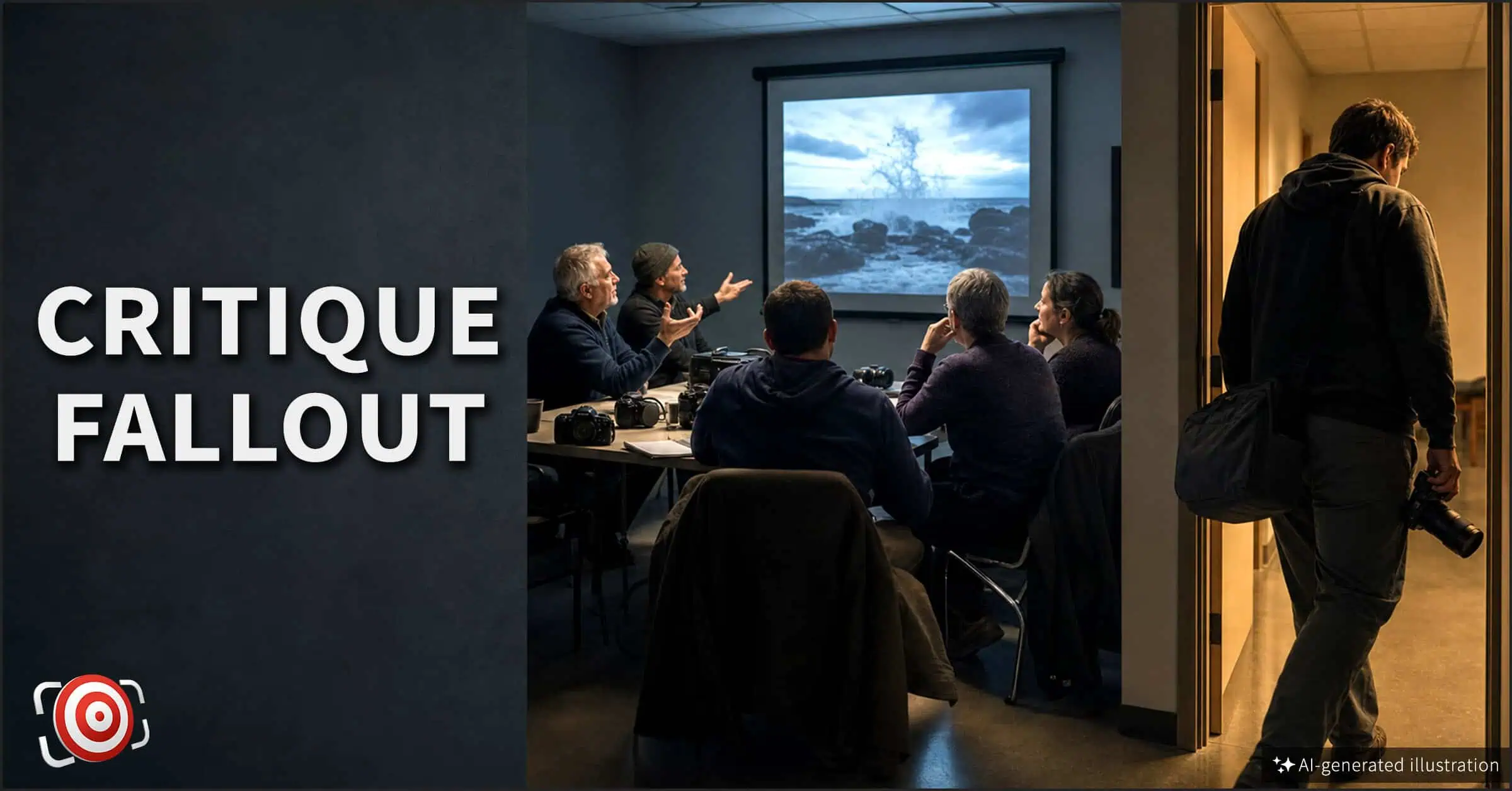
I’ve sat through many annual banquets where the same five photographers win every category, year after year, and I can tell you that takes the joy out of the room every time. Or the scenario where a new member enters an image, gets picked apart by somebody with a clipboard, and doesn’t come back. I’ve watched that exact thing happen more times than I want to count.
Plenty of older members genuinely enjoy competitions, and there’s nothing wrong with that. Just don’t let the scoreboard become the only reason anybody shows up.
The Ones Worth Joining
When you walk into a good club, you can tell inside of five minutes. Nobody talks down to a beginner. A dumb question gets a real answer, not a smirk. And here’s the part that surprised me the first time I noticed it: the member who tried something weird and watched it completely fall apart gets just as much airtime as the one who took home a ribbon, because that failed print usually teaches the room something the winning one never will. Best of all, somebody can stand up and say “I’m stuck” without the room going quiet on them.
Clubs that get this right remember exactly why they exist. Not to judge photographs. To help photographers grow.
If you belong to a club, show up and share what you know. Somebody in that room needs the exact thing you’ve taken for granted for years. If you don’t belong to one, go find one, and if the first one you visit is nothing but a scoreboard with a mailing list, keep looking. They’re not all the same.
Photography may start alone. Mine did, 55 years ago. Almost everything worth knowing since then came from photographers willing to sit next to me and hand it over, and that’s exactly why our community needs strong clubs now more than ever.
Now go pick up that camera and shoot something! Because – “Your BEST shot is your NEXT shot!” — Joe Edelman